
Two documentary films for Arte in which Marc Dozier returns to communities he has photographed for many years. He co-directed them with Quincy Russell, appears on screen, and organised the whole shoot.
By Marc Dozier · Updated November 2026
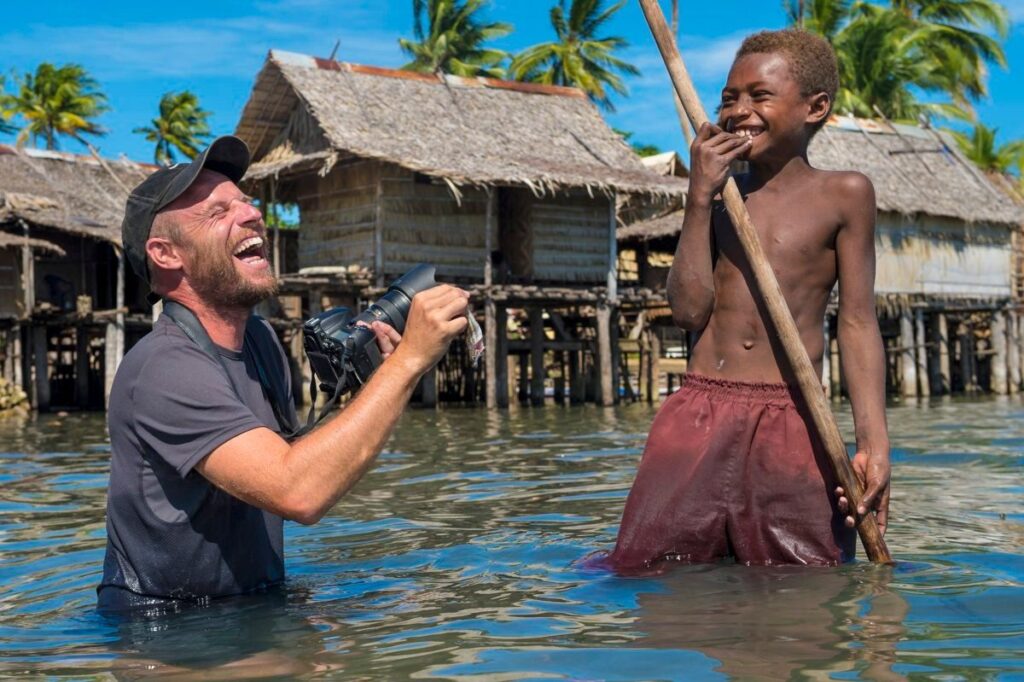
Travelling Photographers (Photographes voyageurs in French) follows photographers back to the places and people they have photographed for years. Two episodes were filmed in Papua New Guinea with Marc Dozier.
In Fire Dancers, Marc returns to Sugu, a Kaluli village deep in the forest, to mourn his longtime friend Papa Minoa and to document the ceremony held in his honour. In Princes of the Pacific, he goes back to Kapo, home of the Kombe people. Marc has known both the Kaluli and the Kombe since the 2010s.
Two small expeditions
Each episode is a 26-minute film, which left no more than five shooting days per location. That is a real challenge in Papua New Guinea, where something always goes wrong, so we built buffer days into the schedule from the start.
Reaching Sugu means a charter flight from Mount Hagen, there and back; the only alternative is a week’s walk each way. Kapo, among the islands of the Gloucester area in West New Britain, is reached by a flight to Hoskins, then by boat. Each location was a small expedition in its own right.
Neither place has any electricity, so the crew had to be fully self-sufficient. That means a generator, and the fuel to run it, carried all the way in: in regions this remote, it is a logistical operation in itself.
In front of the camera, and behind it
Marc appears on screen in both films, which he co-directed with Quincy Russell. Off camera, Papua New Guinea Fixer handled the whole production on the ground: domestic flights and charter planes, logistics, accommodation, security, translation, and the generators that kept the equipment running in villages without electricity.
The crew was deliberately small: three people, Quincy Russell, Pascal Fayolle and Marc Dozier, who was also the fixer. A tight team in which everyone covered several jobs, and the one we would recommend for most shoots in the country.
From the co-director
I worked with Marc in Papua New Guinea on two documentary films, in which he also appeared on screen. As a fixer, he is the real thing. […]
PNG has a very different relationship to life from our Western one. Marc understands its customs and rituals, speaks Tok Pisin, and knows how to read a situation before it turns. Beyond that, his good humour and generosity won over everyone, my crew and the communities we filmed alike.
In PNG, your life can depend on your fixer. I recommend Marc with my eyes closed, and I would only ever go back with him.
Quincy RussellDocumentary filmmaker · Russell Films, Lato Sensu, Mona Lisa Productions · Read on LinkedIn →
What producers can take from it
- Keep the crew small. Filming in Papua New Guinea is expensive. Three people including the fixer is the ideal size, five at most. Choose people who can each cover several roles: camera, sound, drone, direction.
- Budget for access first. A return charter flight, or a flight followed by a boat, can be one of the largest costs of a remote shoot. The alternative is often days on foot.
- Plan for full autonomy. In remote villages there is no electricity: bring a generator and enough fuel for the whole stay, and count them in the logistics from day one.
- Always plan buffer days. Even on a five-day shoot, weather, flights and village life will change the schedule.
More on lead times and paperwork in our guide to filming permits in Papua New Guinea.
The films
| Series | Photographes voyageurs (Travelling Photographers) |
| Episodes | Papua New Guinea – Fire Dancers · Papua New Guinea – Princes of the Pacific |
| Broadcaster | Arte (2019) |
| Directors | Quincy Russell & Marc Dozier |
| Production | Lato Sensu Productions, with ARTE France |
| Our role | Co-direction, on screen, and full production services: flights, charters, logistics, accommodation, security, translation, generators |
Filming with remote communities?
We know the people, the customs and how to arrive and leave on good terms.